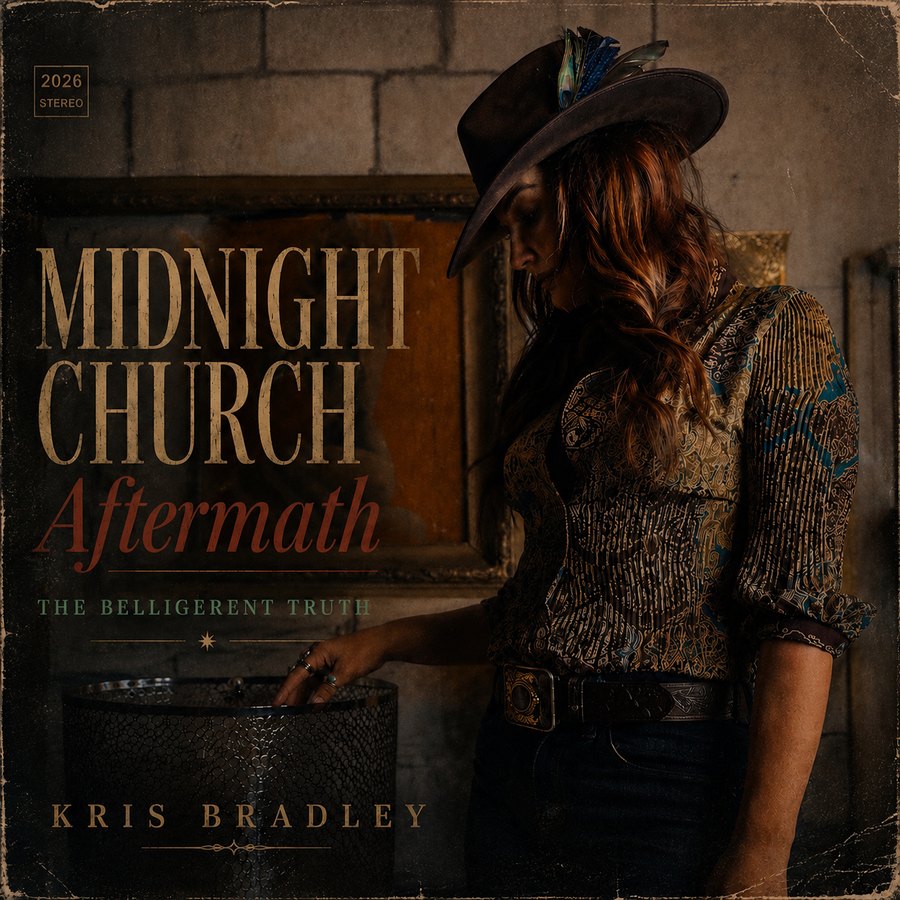
Double album · 26 songs · Country / Americana / Rock
This album has a narrative arc — two acts, one journey. The marketing follows that arc. We don't release songs randomly. We tell the story in order, letting the audience experience the same movement from chaos to clarity that the album charts.
Act 1 Marketing Voice — Disc One
Identity. Hustle. Masking. Burnout. The content here has edge — it's punchy, self-aware, sometimes funny, sometimes raw. This is where Kris is recognizable to people who are still in it. The tone is honest and sharp, not broken-down. She knows exactly what she's doing. She's just finally saying it out loud.
Act 2 Marketing Voice — Disc Two
Surrender. Integration. Spirituality. Love. The content here breathes more. It's warmer, more spacious, more open. This is where listeners who have been following the story feel the exhale. The tone softens without going soft — it's earned, not performed.
The One Rule
"If it doesn't serve the song, the story, or the listener — it doesn't go out. No exceptions."
Platform Posture
Instagram
Primary visual brand home. Reels, stories, behind-the-scenes. Song stories live here.
TikTok
Discovery engine. Hooks, moments, raw takes. One true thing per video.
Email List
The inner circle. Deeper stories, earlier access, real conversation.
YouTube
Long-form home. Music videos, sessions, vlogs from Nashville and beyond.
Facebook
Artist page for community and broader reach, especially older demographic.
Global Content Format — Applies to All 26 Songs
The Work Tape → Finished Track Format
The format: Open with the raw work tape — voice memo, phone recording, whispered demo, airplane recording, whatever you had when the idea hit — then transition into the fully produced finished track. The contrast IS the content.
Why it works: It makes the listener feel like they're witnessing the birth of a song. It's the most intimate thing an artist can share. The rawer and more imperfect the work tape, the more powerful the reveal when the full track hits.
The worse the work tape, the better. A quietly whispered phone recording on a plane with white noise in the background (like The Apple and the Tree) is more compelling than a clean demo. Imperfection is the point — it shows the song existed as a real moment before it was a production.
Execution: Show the work tape on screen (waveform visual or phone screen recording works) — 10 to 20 seconds of the raw moment — then cut to the produced version. No narration needed. The transition does the talking.
Caption angle: "this is what [Song Title] sounded like the day I wrote it." or "every song starts somewhere. this is where [Song Title] started." Keep it simple. Let the audio tell the story.
Works for every song on the record — log work tapes as you find them in each song sheet's stitch section. Even a terrible recording is an asset.
Bonus: For songs with a strong origin story (wrote it on a plane, wrote it at 2am, wrote it crying in the car) — add one sentence of context before the tape plays. That sentence becomes the hook.
Why This Record Exists
The Artist Manifesto
"Don't make art for other people. Make something you really love."
— Rick Rubin
The Tagline — Use Everywhere
Wynonna tells the hard truth.
Kris Bradley tells the belligerent truth.
Spotted on Nashville signage advertising Wynonna Judd. April 2026. The positioning wrote itself. Belligerent = she doesn't just tell it. She insists on it. Bio. EPK. Press pitch. Newspaper. Everywhere.
For years I was a hired gun. I made music for other people, in service of other people's visions, shaped by what I thought the market wanted or what would please the room. It was a good life. I was good at it. But it wasn't mine.
Midnight Church Aftermath is what happens when you stop making art for other people and finally make something for yourself. It's an accumulation of everything — my stories, my truth, and every artist who ever cracked me open. The Judds. Led Zeppelin. Nineties country. Blues-rock. Soul. All of it is in here, not as influence but as identity. This is the record I would have made if no one was watching. And it turns out that's exactly the record I needed to make.
The Three Whys
📀Why It's a Double AlbumTwo acts, 26 songs — the whole arc needs room›
Nobody makes albums anymore. Especially not double albums. That was a deliberate choice — not a statement, just the truth of what the story required. Two acts. Twenty-six songs. The whole arc. You can't tell this story in four tracks and a single. The collapse and the rebuilding both need room to breathe. So I gave them room.
🎸Why Real MusiciansThe opposite of AI-perfect — human, in a room, in real time›
We live in a world where you can generate something that sounds technically perfect in about thirty seconds. And it shows. There's a flatness to it — a kind of sonic uncanny valley where everything is right and nothing is human. I wanted the opposite of that. I wanted the sound of people in a room together, making decisions in real time, bringing their whole lives to the session. Real musicians don't just play the notes. They bring something you can't program.
🎙️Why Dark Horse Recording StudioSome rooms have history in the walls›
Because some rooms have history in the walls. Because the pursuit of an artist career — a real one, with real stakes — deserves to be treated seriously. Because if you're going to make the record of your life, you go to the place where records are made. It's not a flex. It's a commitment to the work.
Why This Matters for Marketing
Marketing Expert Notes — How to Use This
This is a post-album release story — but seed it early. The manifesto angle ("I made this for myself, not for the algorithm") will resonate even before the album is out. Plant the idea in pre-release content so that when the album drops, the audience already understands the context and the intention.
The Rick Rubin quote is your hook. It's famous enough to stop the scroll, personal enough to be yours. Lead with it in the talking-head video version of this story — don't bury it.
The AI contrast is timely and true. "In a world where everything sounds too perfect and nothing sounds human, I made a record with real musicians in a real room" is a genuinely differentiated positioning statement right now. Use it — not as a criticism of anyone else, just as a clear statement of what this is.
The hired gun to artist journey is its own content series. The transition from making music for other people to making music for yourself — that's a story your existing PLAB audience will connect with deeply. They know the "building for others" version of you. This is the reveal of the real version.
The influences are shareable content. A video walking through the sonic DNA of the record — "I grew up on everything from the Judds to Led Zeppelin and it's all in here" — is discoverable across multiple communities and gives you natural entry points into multiple audiences at once.
Long-form home: This manifesto becomes the centerpiece press piece for album launch — pitch it to Americana editorial, music press, and any outlet covering independent artists, burnout culture, or the AI-vs-human conversation in music.
Opening Hooks — For the Manifesto Content
"Rick Rubin said don't make art for other people. Make something you really love. I spent years not doing that. This album is what happens when you finally do."
"Nobody makes double albums anymore. Nobody hires real musicians anymore. Nobody goes to a legendary Nashville studio just to make something honest anymore. So I did all three."
"I grew up on the Judds, Led Zeppelin, and nineties country. All of it is in this record. Not as a reference — as a confession."
"In a world where AI can make something that sounds perfect in 30 seconds, I went to Nashville and made something that sounds human. That was the whole point."
"I was a hired gun for years. I was good at it. But I was making music for everyone except myself. This album is what I was actually trying to say the whole time."
"26 songs. Two discs. Real musicians. One iconic studio. Nobody told me to do it this way. That's exactly why I did."
Coined Term — "Neuroconvergence" (KB Original)
The term: Neuroconvergence — coined by Kris Bradley. A portmanteau of neurodivergence + convergence.
What it means: The moment where neurodivergence and perimenopause converge — two things that were always running parallel suddenly hitting at the same time and explaining everything. Late-diagnosed AuDHD women entering perimenopause often experience a sudden intensification of both sets of symptoms simultaneously. The convergence is the crisis and the revelation at the same time.
Why it matters: This experience has no name yet. KB just named it. That's a content franchise, a community anchor, and a potential marketing identity. The women who recognize themselves in this word will share it before they've heard a single note of music.
Marketing applications:
"I coined a word for something that happened to me. Neuroconvergence. The moment your neurodivergence and perimenopause hit at the exact same time. Nobody talks about this. I wrote an album about it."
"Neuroconvergence is when your late-diagnosed ADHD and your perimenopause decide to introduce themselves at the same time. It explains a lot. I wrote 26 songs about it."
"Nobody had a word for it so I made one. Neuroconvergence. If you know, you know."
"The thing nobody talks about: perimenopause and neurodivergence hitting simultaneously. I'm calling it neuroconvergence. And it's the reason this album exists."
Song connections: Fireproof (the burnout that was actually neuroconvergence in disguise), Walking Contradiction (the identity unraveling), Shapeshifter (the masking finally breaking), One Wish (the collapse into surrender). Ask KB which songs were written specifically from inside this experience.
Content angle: This term deserves its own long-form YouTube piece (LF-05) and its own short-form series. "Let me explain neuroconvergence" is a talking head that could reach an entirely new audience — women in perimenopause who haven't been diagnosed yet and are trying to understand why everything got harder at once.
Protect it: This is an original coined term. Use it consistently and own it publicly before anyone else picks it up.
The One-Line Bio — Family of Four
Primary — EPK, Press, Newspaper
"Somewhere between the Judds, Led Zeppelin, and a dive bar."
Leads with rawness. Stands alone. The most universal door into the record.
Kacey Version — For Small Talk, Fix My Life, Wit-Forward Context
"Somewhere between the Judds, Led Zeppelin, and talk therapy with Kacey Musgraves."
Earned — Small Talk and Fix My Life genuinely sound like Kacey. Use when those songs are the entry point.
Tight Kacey Version — When You Want the Reference Without the Explanation
"Somewhere between the Judds, Led Zeppelin, and a Kacey Musgraves deep cut."
Implies the wit and emotional intelligence without spelling it out.
Standalone — Funniest, Most Self-Aware, Caption / Social Bio
"Somewhere between the Judds, Led Zeppelin, and talk therapy."
Drop Kacey entirely. The therapy line is funny and specific on its own. Completely KB.
Use situationally — dive bar for EPK and press, Kacey version when Small Talk or Fix My Life are the entry point, talk therapy standalone for social captions and humor content.
Ready-to-Post Carousel — "Things I Can Do Because I Don't Have a Label"
Instagram Carousel — 12 Slides — Post As-Is or Refine
Slide 1 — Hook: "things I can do because I don't have a label."
Slide 2: "make a 26-song double disc concept album. and not apologize for it."
Slide 3: "refuse to pick a genre. country. blues. rock and roll. all of it. because that's what I actually listen to."
Slide 4: "make the songs as long as they need to be. not 3:30. not 2:45. as long as the song requires. because the song decides. not the algorithm."
Slide 5: "record the whole thing in 432hz. not 440. 432. look it up."
Slide 6: "hire real musicians to play every single note. no programmed parts pretending to be human. actual humans. actually playing."
Slide 7: "leave the lead vocals untuned. the way they used to. because the feeling matters more than the pitch."
Slide 8: "write guitar solos back into songs. actual parts. actual players. like it's 1972 and nobody told us to stop."
Slide 9 ⭐: "use a real theremin for the synth sounds. the one that used to belong to Nine Inch Nails. because why wouldn't you." — THIS slide will stop scrolls. Screenshot bait.
Slide 10: "create a title track that blends multiple genres and weaves songs from across the entire record into one single listening experience. a record within the record."
Slide 11: "the freedom to make something weird and true and completely mine. that's the whole point."
Slide 12 — Closer: "Midnight Church Aftermath. coming 2026. Kris Bradley tells the belligerent truth."
Caption: "a label would have stopped me at slide 2." or just "." — let the carousel speak.
Production Detail — Log for Song Sheets
The NIN Theremin: A real theremin used on the record — the instrument previously owned by Nine Inch Nails. Log which song(s) feature it when confirmed. This detail belongs in every relevant song sheet, the EPK, and any press pitch. It is genuinely one of the most interesting production facts on the record.
Untuned lead vocals: A deliberate production choice — feeling over pitch correction. Flag in relevant song sheets as a sonic identity note.
Song length freedom: No songs were cut to format length. Each song runs as long as it needs to. Note in EPK and press materials as part of the independent artist positioning.
Title track as a record within the record: The Midnight Church Aftermath title track blends multiple genres and weaves hooks from songs across the full album into one listening experience. This is the album's centerpiece and should be treated as its own content moment at album release.
🎬 Album Launch Asset — The "Now That's What I Call Music" Spoof Commercial
The concept: A spoof infomercial modeled on the Now That's What I Call Music CD commercials from the 80s and 90s. Deep radio voice, slightly over-the-top delivery, scrolling through the songs like a late-night TV spot. Nobody is doing this. Universally recognizable for the 25–65 audience.
Why it works: The spoof lands because the record actually IS that kind of eclectic multi-genre collection. The humor is the delivery — the content is real and true. The more sincere the voice, the funnier it gets.
The voice: Mike D or anyone with a deep gravelly old-school radio announcer voice. Play it completely straight. Let the absurdity do the work.
Draft script: "Are you tired of music that sounds like it was made by a computer? Do you miss when songs told real stories? When real humans played real instruments? When albums had guitar solos? Well NOW you can have ALL of that... and MORE. Introducing... Midnight Church Aftermath. 26 songs. TWO discs. ONE neurodivergent woman from Maui who went to Nashville and nobody stopped her. You get country. You get blues. You get rock and roll. You get a theremin that used to belong to Nine Inch Nails. Songs like... Fireproof. Walking Contradiction. Making God Laugh. And so much MORE. All recorded in 432hz. With REAL musicians. NO AI. NO autotune. NO label telling us what to do. Midnight Church Aftermath. Available everywhere music lives."
The disclaimer — tiny voice, fast legal read: "Warning: this music may cause you to tell the belligerent truth, cry in your car, question everything you've been doing for the last twenty years, or sh*t your pants."
The button — cut to old couple on couch, both laughing. Wife looks at camera: "My husband did." FREEZE FRAME. Don't cut away. Let it sit. That's the joke. Then: "Midnight Church Aftermath. Available everywhere." The freeze frame after "my husband did" is everything. Nobody sees it coming. That's the whole point.
Visual treatment: VHS aesthetic — scan lines, slight color bleed, 90s TV commercial look. Song titles scrolling. Intentionally nostalgic production value.
Timing: Album launch — January 2027. Cut a 15–30 second teaser version for social in the weeks before album drop.
Platforms: YouTube long-form. Instagram Reel cut-down. TikTok version. One of the most shareable pieces on the entire rollout — people will send it to friends.
Where it lives in the rollout: Album launch asset. Physical version goes in the free-plus-shipping package alongside the card and the map.
Nobody's playlist is just one thing anymore. The streaming era proved that we were never really one genre — we just pretended to be because that's how radio worked. Midnight Church Aftermath doesn't fit in a box. Country. Americana. Blues-rock. Soul. Classic rock. All of it is in here because all of it was always in Kris. That's not genre confusion. That's genre honesty.
The Multi-Genre / Multi-Passionate Angle — Content & Marketing
The core truth: People are more multi-passionate and multi-genre today than at any point in music history. Nobody who loves Miranda Lambert doesn't also love something completely different. The listener this record is for grew up on the Judds AND Led Zeppelin AND 90s R&B AND whatever else was on in the house. This record sounds like that.
The neurodivergent connection: The AuDHD brain is almost always multi-passionate and resistant to being categorized. The record is literally built like that brain. That's not a coincidence — it's a feature. Your audience will recognize themselves in the eclecticism of it.
The positioning line: "I didn't make a country album. I made a Kris Bradley album. It has country in it. And blues. And rock. And soul. And whatever else needed to be there."
Why this matters for reach: Not being one genre means you're not limited to one audience. Country fans, Americana fans, blues-rock fans, classic rock fans — all of them have a door into this record. The multi-genre angle is actually a discovery strategy, not just an artistic statement.
The industry reframe: Genre is a filing system. It's not a personality. This record was made for the people who always knew that.
Opening Hooks — The Genre Angle
"Nobody's playlist is just one thing. Neither is this record."
"I grew up on the Judds, Led Zeppelin, and 90s country. Midnight Church Aftermath sounds exactly like that."
"Country/Americana/Blues/Rock. Pick one. I couldn't."
"The streaming era proved we were never just one genre. This record was made for the people who always knew that."
"Genre is a filing system. It's not a personality."
"I didn't make a country album. I made a Kris Bradley album. It has country in it. And blues. And rock. And soul. And whatever else needed to be there."
"Nobody who loves Miranda Lambert only loves Miranda Lambert. This record is for that person."
"We're all multi-genre now. The algorithm knows it. Your playlist knows it. This album knows it."
Personal Symbol — Used Sparingly
The Octopus
"The octopus is a whisper, not a shout. If anyone outside the inner circle has to ask why the octopus is there, it's too prominent."
The octopus is Kris's personal symbol — long-standing, predating the MCA brand. It's not a logo, not a mascot, and not a marketing centerpiece. It's a quiet through-line that lives in the world of the brand as a subtle visual signature.
Why It Matters
The 8 arms mirror the multi-passionate AuDHD brain — hyperfocus on multiple things at once
Camouflage mirrors the masking experience and ties directly to the Shapeshifter song
The autism community has adopted the octopus as a representative symbol — the audience already recognizes it
Like Kris, an octopus doesn't fit neatly into any single category — genre-mutt energy
Where It Belongs — Priority Placements
Live performance: A vintage brooch worn at every live show. Let it become a ritual fans recognize and look for. Sourced organically — vintage shops, estate sales, Etsy. The "I found this brooch in a tiny shop on the last day of recording" story is part of the symbol's lore.
Music videos: One subtle Easter egg per video. Never two competing references. Examples — an octopus statue on a shelf, a ring in a closeup, wallpaper with a faint octopus pattern, a small figurine on a windowsill or dresser, an octopus charm on a bracelet. The goal: deep fans rewatch and screenshot. Casual viewers never notice.
Album packaging: A small octopus printed inside the vinyl gatefold or as a watermark on the back of the physical lyric booklet. Discoverable only by people who buy the physical product.
Website: Consider as the favicon (browser tab icon). Or a tiny animated octopus that occasionally appears in a corner. Subtle.
Stage setup: Optional small octopus brooch on a mic stand or a small figurine on the amp. Performance-side Easter egg.
Personal signature: When Kris hand-writes notes to fans or signs physical merch, occasionally draws a tiny octopus next to her name as a personal mark.
Internal documents: Possible page divider or footer illustration. Light.
Future Merch — Not Day One
Eventual "Octopus Club" pin — a replica of the brooch Kris wears live — for the most dedicated fans. Limited drop. Let the symbol earn its way into merch through fan recognition first.
This is a Phase 3+ conversation. The symbol needs to live in the world before it becomes a product.
Where It Does NOT Belong — Yet
The logo with "Kris Bradley" — defer 6–12 months. Let the octopus live in the world first. If it earns its way into the logo through fan recognition and organic association, lock it in then. Symbols that earn their way feel inevitable. Symbols assigned in week one feel forced.
Centerpiece marketing imagery — never. The octopus is not the brand. It's a signature inside the brand.
Framing If It Comes Up in Interviews or Content
"I've loved octopuses for years — and I love that the autism community sees themselves in them too."
The symbol is Kris's first. The community resonance is a bonus, not a borrowed identity.
Never frame it as "I picked the octopus because the autism community uses it." The order matters.
Execution Notes — Per Team Member
Mike (music videos): One subtle octopus per video. Discuss placement in pre-production for each shoot. Never two competing references in one video — pick the one that fits the room.
Justin (videography): Same rule. Watch for opportunities in B-roll. Don't force it — if it's not there naturally, leave it out.
Stylist: A brooch consideration is on the radar for live performance styling. Vintage finds welcome.
Cowork (web build): Octopus favicon is in scope when the marketing-sop site is built. Subtle corner animation is optional, not required.
All team members: When in doubt, leave it out. Too much is worse than none. A symbol used 8 times across a year is more powerful than one used 80 times.
The Four Golden Rules of Viral Content Marketing
Rule 1 — Specificity beats vague. "Welcome to my studio tour" triggers the mental spam filter. "Here are the five pieces of gear I used to record Fireproof" stops the scroll. The more specific you are, the more people feel it was made for them. You think being too specific won't reach a large audience. The opposite is true — being too general is why nobody resonates. Name the thing. Name the gear. Name the person. Name the feeling. Get specific every time.
Rule 2 — Tension beats calm. The doomscroller is emotionally flatlined. Your job in the first 2–3 seconds is to interrupt that. The algorithm rewards content that makes people feel something — scared, nervous, joyful, sad. You don't need a car going off a bridge. Tension lives in the scripting, in the setup, in the first line. Study movie trailers — their one job is to create tension in 90 seconds. Apply that psychology to every piece of content.
Rule 3 — Your personality is your moat. The weird things, the quirks, the self-deprecating humor, the flaws — those are what make you uncopyable. ChatGPT can't replicate your personality. Two artists can use the exact same format and get radically different results because of who they are. KB's moat: the wry self-awareness, the AuDHD brain, the "we are ready. probably." energy. That's not decoration. That's the product. Lean into it every time.
Rule 4 — Volume unlocks luck. Kels posted 500 times before "Gone" went viral. Nobody knows what will hit — not even people who study content full time. Major labels have flops constantly. Post more, study the analytics, double down on what works. Don't do volume for volume's sake — apply the best knowledge you have AND post a lot. Perfectionism is the enemy of shot count. Get the shots up.
Free Resource — 200 Viral Content Ideas
URL: onemoreTime.fm/200viral — completely free, no upsell, shareable with collaborators
What it is: 200 proven content ideas with a star-save system and share links. Ideas are organized into buckets and formats. Share individual ideas directly with Justin, Jeff, or Blue.
How to use it: Browse, star the ideas that fit MCA's world, share the relevant ones with collaborators. Run through it once before each six-week release cycle and pull 5–10 ideas to add to the content calendar for that song.
The KB filter: Apply the four golden rules to every idea you pull. Specificity — make it about Fireproof/MCA specifically, not music in general. Tension — does the first 2–3 seconds create a feeling? Personality — does it sound like KB or does it sound like anyone? Volume — if it passes those filters, post it. Don't overthink it.
Where This Comes From
Album Origin Stories
📖 The John Kalodner Story (ST-01)
Sitting in the passageway at MI in Hollywood at 22. John Kalodner (A&R executive — Geffen, Columbia; known for Aerosmith and Journey) approached, said she had a good look, and brought her into his office.
He played songs he wanted her to sing and asked, "How would you feel touring the world singing these songs?" Her honest answer: "I'd be miserable." They weren't hers.
He wished her luck and said she needed to write better songs and learn guitar. Best advice she ever got.
Core beat: Refusing the version of yourself someone else built.
⚠️ Note: Get his title right — A&R executive, not producer.
Hidden in Plain Sight
The 432hz Easter Egg
The clock concept, the reveal strategy, and the confidentiality rule. Nothing here goes public until KB says so.
⚠️ The Clock — Set Dressing Rule for Every Video (from the videographer brief)
A vintage clock (1970s or 1980s style) set to 4:32 must appear somewhere in every music video. It does not need to be prominent — in fact it should be subtle enough that most viewers miss it on first watch. This is intentional album architecture.
The clock represents 432hz — the tuning frequency the album is recorded in (vs the industry standard 440hz). Do NOT call attention to it on screen. It should feel like set dressing. The audience finds it.
Confidentiality: This detail is confidential until KB reveals it publicly.
Carousel tie-in (slide 5): "record the whole thing in 432hz. not 440. 432. look it up."
The 432hz Easter Egg — Reveal Content (Use After Someone Finds It)
The Clock Reveal — Hooks & Captions
What it is: A vintage 1970s/80s clock set to 4:32 appears somewhere in every MCA music video. It represents 432hz — the tuning frequency the album is recorded in, vs the industry standard 440hz. It is intentional album architecture hidden in plain sight.
When to reveal: Either when someone notices it organically in the comments and posts about it — or as a deliberate reveal piece after at least 2–3 videos are out and enough people have watched to make the discovery feel earned.
The reveal hook: "If you've watched any of my music videos and noticed the clock — that's not decoration. The album is recorded in 432hz. Most music is recorded in 440. I'll let you go down that rabbit hole yourself."
Alternative reveal hooks:
"There's something hidden in every one of my music videos. Nobody's found it yet. I'll wait."
"A vintage clock appears in every MCA music video. It's set to 4:32. That's not an accident."
"432hz vs 440hz. Look it up. Then go back and watch the videos."
"I encoded the album's tuning frequency into every music video as a clock. Because I'm that person."
Why this works: 432hz is already a rabbit hole the internet loves — there are passionate communities around it. The moment the reveal lands, those communities find the music. The vintage clock also ties perfectly into the visual world of the album — blue hour, warm low-mids, nothing shiny. It looks like it belongs there. That's the point.
Comment bait follow-up: After the reveal post — "drop a 🕐 if you spotted the clock before I told you." Comments become the content.
Current outreach status — updated July 15, 2026:
✅ Lauren Rearick / The Grey Estates — pitched July 15 (premiere pitch)
✅ Mike Friedman / Skope — pitched July 15 (premiere pitch)
✅ A&R Factory — submitted July 15 (premium $40 submission)
✅ Twangville — pitched July 15 (premiere pitch to requests@twangville.com + todd@twangville.com)
✅ Brownstone Cowboys — pitched July 15 (feature/interview pitch to howdy@brownstonecowboys.com)
⏳ The Alternative — not yet sent
⏳ American Songwriter — hold for album cycle
⏳ AMNPLIFY — not yet sent
⚠️ Premiere window closes July 17 — all premiere pitches are now sent
Promotes MCA as a Whole — Not Tied to Any Single
Hooks & Opening Lines — Album Level
Every hook that sells the record rather than one song. Pulled from the Hook Library and kept verbatim. Song-specific hooks live on the song pages.
🎣 Album-Level Hooks — Where the Big Ones Live on This Page
Genre mutt + double album story hooks: "nobody's playlist is just one thing" / "genre is a filing system, not a personality" / "26 songs, nobody stopped her" / "I made a Kris Bradley album" → Opening Hooks — The Genre Angle
"i'm 43 and I decided to bet on myself anyway." and the midlife authenticity hooks → below, and on the Audience Map
Song-specific hooks (Fireproof, Walking Contradiction, Making God Laugh "Nobody Wants to Hear" versions, POVs, This Is Proof) live on each song's page. The full source archive is the Hook Library.
Verbal Hooks — One-Liners That Open a Video
"I wrote a song about this and I'm not even sorry."
"Nobody told me this was allowed." [then say the thing]
"This is either really relatable or I'm the only one — let me know."
"I've been wanting to say this for about fifteen years."
"Here's the thing nobody actually talks about." [then say it plainly]
"This is going to sound dramatic but it's actually just Tuesday."
"I wrote this at [specific weird moment] — and somehow it became a whole song."
"Fair warning — this one's going to hit different if you've ever [specific situation]."
"I don't know who needs to hear this but it might be you."
"Okay so this is embarrassing but also extremely relatable."
"I'm just going to play you something and you tell me if this is just me."
"I didn't plan to write a song about this. And then I did."
"This lyric came out of me and I had to sit with it for a minute."
"The honest version of this story is kind of a lot. But here it is."
"I spent [X years] not saying this out loud. Then I wrote it into a song."
Humor Hooks — On-Brand Funny / Self-Aware
"I wrote 26 songs because I hyperfocused for two years and nobody stopped me. You're welcome."
"My ADHD said write one song. My autism said make it a concept album. We compromised with 26 tracks and a double disc. This is fine."
"Neurotypical people make EPs. I made a 26-song double album. I don't make the rules. Actually I do make the rules. There are a lot of rules."
"I didn't realize I was masking until I stopped and suddenly couldn't talk to anyone at a party. Wrote a song about it. Then 25 more."
"Fun fact: hyperfocus is just passion with no off switch. Midnight Church Aftermath is what happens when hyperfocus meets a guitar and a recording studio."
"I rehearsed this casual conversation with you approximately 47 times before posting it."
"I wrote 26 songs on a double album because I have ADHD and nobody stopped me."
"This is what happens when you give a neurodivergent woman a guitar and too many feelings."
"Normal people write singles. I wrote a double album. Anyway, here's track seven."
"My producer said 'this is too long.' Reader, I did not cut it."
"For anyone who has ever been called 'a lot' — hi, I made you an album."
"Late diagnosed AuDHD means I spent 40 years thinking I was broken. Turns out I was just running software nobody else had the manual for."
"The thing about masking for decades is eventually the mask gets so heavy you can't remember what your actual face looks like."
"I didn't burn out because I was weak. I burned out because I was running a full band on a single instrument for 40 years and calling it normal."
"The neurodivergent experience: doing everything ten times harder than everyone else and still believing you're the one falling behind."
"I was the most organized, most prepared, most on-top-of-it person in every room. I was also completely exhausted every single day. Turns out those two things were related."
Funny Meets Honest — The Sweet Spot
"I cannot small talk but I can write you a 26-song double album about the human condition. My brain is very normal and fine."
"Neurotypical people said I was too intense. I said okay and wrote an album. Joke's on everyone — the album has 26 songs."
"I don't have an off switch. I have a 'write a concept album about burnout, identity, and spiritual transformation' switch. Same thing basically."
"My nervous system said rest. My brain said but what if we made a double album first. We compromised. The album exists. My nervous system is still mad."
"I spent my whole life being 'a lot.' Turns out a lot was exactly the right amount for this record."
Strategic Hooks — Generated from the Tyler Wise Prompt Framework
Fear & Desire Hooks — MCA Ideal Customer
"What if burnout wasn't a breakdown — it was your body finally telling you the truth?"
"I had everything I was supposed to want. I was miserable and I didn't understand why."
"I was so good at being what everyone needed that I completely forgot what I actually was."
"Everyone else seemed to know who they were by 30. I was still figuring it out at 45. Turns out that's not a failure. That's the whole story."
"I spent decades thinking something was wrong with me. Then I got a diagnosis and realized I'd just been running the wrong operating system my whole life."
"The version of me that burned out was not the real me. But I had no idea who the real me was either. That was the scariest part."
"I tried everything. Therapy. Manifestation. Productivity systems. Crystals. None of it was wrong — none of it was enough."
"There is a version of your story that you have never said out loud. Not because it isn't true — because you weren't sure anyone could handle it."
"I walked away from music for years to build something responsible. The responsible thing almost killed me. So I came back."
"You are allowed to want something just because it's yours. Not because it's productive. Not because it helps anyone. Just because it's the truest thing about you."
Paired Captions — One Per Hook
"I wrote a whole album in the aftermath of that question."
"Turns out the trophy doesn't come with instructions for what happens next."
"There's a song on this record for the version of you that's exhausted from being everything to everyone."
"This record is for the late bloomer who thought the window had closed. It hadn't."
"I wrote Walking Contradiction before I had the word for it. Turns out the word was AuDHD."
"The album starts in the collapse and ends in the coming home. That's the whole journey."
"There's a song called Anything But Jesus that says the quiet part out loud."
"This record is what happens when you stop editing yourself for the room."
"The hired gun becomes the artist. That's the real story behind this record."
"That's why I made a 26-song double album. Because it was mine. Full stop."
How to Use These
Each hook + caption pair is a complete standalone post — hook opens the video or carousel, caption closes it
Use as talking-head openers — say the hook directly to camera, then tell the story behind it, then play the relevant song
Mix and match — the hook from #3 can pair with the caption from #8 if it feels right
Run the Tyler Wise prompt again at the start of each six-week cycle with the specific single as the offer — you'll get 10 new ones tailored to that song
The ones that get the most saves and shares tell you exactly which fear or desire your audience is sitting in right now
Neuroconvergence — KB Original Coined Term
Neuroconvergence Hooks — Own This Word
"I coined a word for something that happened to me. Neuroconvergence. The moment your neurodivergence and perimenopause hit at the exact same time. Nobody talks about this. I wrote an album about it."
"Neuroconvergence is when your late-diagnosed ADHD and your perimenopause decide to introduce themselves at the same time. It explains a lot. I wrote 26 songs about it."
"Nobody had a word for it so I made one. Neuroconvergence. If you know, you know."
"The thing nobody talks about: perimenopause and neurodivergence hitting simultaneously. I'm calling it neuroconvergence. And it's the reason this album exists."
"Let me explain neuroconvergence." ← standalone talking head opener. No further context needed. The women who need this word will stop scrolling immediately.
"Neuroconvergence. Noun. When your undiagnosed neurodivergence and your perimenopause meet for the first time and explain the last 20 years simultaneously."
This is an original coined term by KB. Use it consistently and publicly. Own it before anyone else picks it up. Candidate for LF-05 long-form YouTube — "Let me explain neuroconvergence."
Yuusic Hook Templates — Fully Adapted for KB / MCA
🚫 Never Use These — The White Noise List
"Out now!" — invisible. Zero value.
"New music out everywhere." — data, not a hook.
"My new single just dropped." — sounds like a bot.
"Available on all platforms." — nobody cares.
"Go stream my song." — a demand, not an invitation.
"Listen now." — same problem.
"Check out the link in bio." — laziest CTA in music marketing.
"Support independent music." — guilt is not a hook.
⭐ Tier 1 — Strongest Adaptations for KB
"i'm 43 and i decided to bet on myself anyway." → use for any artist identity content, Nashville content, manifesto
"pov: you just found a 43-year-old woman who burned out, got diagnosed AuDHD, and wrote 26 songs about it." → perfect pre-release discovery hook
"if you wish you found an artist before they blew up… hi." → dark horse energy, debut launch content
"these two styles shouldn't work — but they do." → the Judds meets Led Zeppelin content, genre mutt angle
"adding instruments where they don't belong." → cowbell content for Shaped By My Sin specifically
"i felt too much — so i turned it into 26 songs." → manifesto, album story content
"ok but imagine driving through Maui and this comes on." → location-specific, highly shareable
"i was in burnout for three years… and this song came out." → Fireproof story content
"I learned something painful — then wrote an album about it." → album story angle
"pov: you lived the burnout, then you made the song." → Fireproof POV series
"trying to revive a sound that deserved better." → real musicians / anti-AI manifesto
"crazy how years of work can change from one person pressing play." → pre-save CTA content
Tier 2 — Strong with the Right Song or Moment
"some of the most honest lyrics I've ever written." → use before any lyric drop
"these words hit harder than I expected when I wrote them." → vulnerable lyric reveal content
"showing this to friends who miss that era of music." → classic rock DNA content, Ready to Lose
"if a season had a soundtrack, this would be on it." → mood-forward, works for multiple songs
"someone compared this to the Judds meets Led Zeppelin and now I can't unhear it." → bio line content
"wait… is this sound back?" → classic rock revival angle, Ready to Lose
"no one expected country and Led Zeppelin to work this well. here we are." → genre mutt content
"if you like Brandi Carlile but also love Chris Stapleton — this is for you." → audience targeting hook
"told myself I'd stop writing songs about burnout… I lied. here's another one." → humor angle, multiple songs
"I think this album is something people need right now." → manifesto content, album launch
"leaking unreleased ideas — one song at a time." → pre-release tease content
"someone streamed Fireproof an unhealthy number of times yesterday." → post-release social proof
"this is exactly what a three-year burnout feels like." → Fireproof, Shapeshifter
"for anyone who's been missing that sound." → classic rock audience targeting
"I wrote this about something that actually happened." → story reveal before any song
"pov: you're in the exact moment this song was written for." → POV series for any song
"if you're hearing this, your taste checks out." → compliments the listener, discovery content
"music from the 70s just hits different. so I made some." → classic rock DNA content
"old-school energy. modern truth. one double album." → album summary hook
"looks easy. absolutely isn't." → behind the scenes, real musicians content
"I think I got a song for the Judds / Led Zeppelin / Kacey Musgraves fans' playlist." → playlist targeting
"since they won't collab… I made a record that sounds like all of them." → genre mutt angle
"imagine hearing this at sunset on the water in Maui." → Maui location content
Tier 3 — Situational / Use When the Moment Fits
"quick look at what we just made in Nashville." → studio BTS content
"this song officially drops July 31st." → release date announcement (add pre-save link)
"what feeling does Fireproof give you." → comment bait post-release
"anyone else noticing music shifting back toward real instruments." → manifesto angle, timely
"this hits different with the right people around you." → live show content, fan community
"what song always gives you that feeling — for me it's this one." → audience engagement
"The best part of the song — easily." → use over the bridge of Fireproof specifically
"I've never written a song this fast before." → work tape reveal, origin story content
"should this drop sooner or later? asking for a friend." → pre-release engagement, tease
"someone said this sounds like the Judds and Led Zeppelin had a baby and now I can't unhear it." → bio line
"hey, I'm Kris Bradley and this is what I do." → introduction content for new audiences
"made this album… still clocking into real life every day." → relatable independent artist content
"a song made for people who've been through this." → emotional targeting, any burnout song
"can someone please send this to anyone who needs it." → share CTA, works for Fireproof bridge
"this is pure emotion. no notes." → lyric drop, minimal caption
"the playlist that gets it." → curator playlist strategy content
"curated for the late-night aftermath." → MCA playlist hook
"pov: you've been doomscrolling and finally found something real." → discovery content
Midlife Authenticity — A Recurring Content Pillar
Standalone — No Music Needed. Just True.
"I didn't choose to be authentic. I just ran out of energy to be fake." ⭐
"Maybe you didn't have to hit midlife to get here. Lucky you. I did." ⭐ — KB's exact words. Don't change them.
"You spend the first half of your life building a version of yourself everyone can tolerate. You spend the second half quietly taking it apart." ⭐
"Midlife doesn't break you. It just runs out of patience for the version of you that was never real."
"Midlife forces authenticity. Not because you get wise. Because you get tired."
"There comes a point where the mask gets too heavy to hold up. For some people that's midlife. For neurodivergent people it's usually a diagnosis. Either way — same moment."
"Midlife authenticity isn't a glow up. It's more like — I simply no longer have the bandwidth to pretend."
"I used to be a lot of things for a lot of people. Then I turned 40 and the budget ran out."
"40s hit different when you're neurodivergent. By then you've been masking for 40 years. The body sends an invoice."
"The midlife authenticity crisis and the AuDHD burnout are the same thing. The mask just got too heavy."
The Cowbell Series — For Shaped By My Sin + General Album Story Content
Cowbell Hooks — Humor / Real Musicians Angle
"Name one thing wrong with modern music. I'll go first. Not enough cowbell."
"I went to Nashville and put cowbell on a record in 2026. You're welcome."
"My co-producer said 'do you want cowbell on this?' I said yes immediately. No hesitation. Zero regret."
"We're bringing cowbell back. Nobody asked. We're doing it anyway."
"The problem with music today is nobody has the audacity to add cowbell anymore. I have audacity."
"Somewhere between the algorithm and the AI-generated music, we lost the cowbell. I found it. It's on my record." ← Best for Shaped By My Sin — ties humor to the real musicians manifesto
"I need you to know that there is real cowbell on this album. Played by a real human. In Nashville. In 2026."
"Why don't songs have more cowbell anymore? I asked myself this. Then I went to Nashville and fixed it."
"Hot take: every song is better with cowbell. I tested this theory. The data supports it." ← Best comment bait
"I didn't go to Nashville to be reasonable about cowbell." ← Most on-brand
Primary home: Shaped By My Sin song sheet. Also works as standalone manifesto content — connects the cowbell humor to the real musicians / authenticity angle. Note: cowbell is confirmed in the pre-pro book so this isn't just a bit. It's a real bit.
The "Nobody Wants to Hear" Series — Self-Deprecating Mirror Format (Template #004)
🎯 General / Double Album Story
"Nobody asked a 43-year-old woman to make a 26-song double album. She did it anyway."
"Nobody stopped a 43-year-old woman from making a double album. That's on all of you."
"Nobody warned Nashville a 43-year-old woman from Maui was coming. Sorry Nashville."
"Nobody wants to hear a 43-year-old woman cover Led Zeppelin in a country song."
"Nobody wants to hear a 43-year-old woman sing classic rock country."
"Nobody told a 43-year-old woman with a heating pad and a bowl of supplements to make a record. Here we are."
Marketing Expert Notes — How to Use This Library
Rotate hooks on the same content. Take one piece of content — say, the Fireproof bridge lyric — and post it three times with three different hooks opening it. Same lyric, different entry point. Track which hook drives more watch time and saves. That data tells you what your audience responds to without you having to guess.
Physical + verbal together. The strongest hooks combine both — a physical action that creates the visual pause, then a verbal line that creates the curiosity. Example: slow sip of coffee, set it down, look at camera, "I wrote this at the bottom of a burnout." Two seconds. Total attention.
Never open with "so" or "hey guys" or "okay so I wanted to share." These are scroll killers. Start in the middle of the moment or start with the hook. No warm-up.
The humor hooks are not separate from the brand. Self-aware humor about making a double album, being neurodivergent, going to Nashville — that's completely aligned. It shows confidence. It shows you don't take yourself too seriously even when the music is serious. Use it.
Log what works. When a hook outperforms, note it in the song sheet for that release. Over time you'll build a personal data set of what your specific audience responds to — that's more valuable than any general best practice.
The "already-in-it" format is your secret weapon. It's the hardest to fake and the easiest to do authentically if you just let the camera roll while you're already working. It requires zero performance and delivers maximum authenticity — which is exactly your brand.
The Curator Playlist Strategy — Organic + Paid Two-Step
Build a Playlist → Go Viral on TikTok → Run Ads to It
Step 1 — Build the playlist: Create a Spotify playlist for each single AND one for the full album. Feature similar artists at the top — Brandi Carlile, Miranda Lambert, Chris Stapleton, Kacey Musgraves, Bonnie Raitt, Brandy Clark — with KB's song(s) woven in. Name it something evocative that lives in the MCA world. Not "Kris Bradley playlist." Something like "late night aftermath" or "the belligerent truth playlist" or "music for people who feel too much."
Step 2 — Make the TikTok first: Before running any ads, make a viral TikTok about the playlist. Format options: "I made a playlist for people who [specific feeling] — no skips" or "pov: you found the only playlist you'll need this [season]" or "I curated this so you don't have to." The goal is organic discovery first — let TikTok do the work before spending money.
Step 3 — Run Meta Ads to the playlist: Once the playlist has organic traction, run a low-budget Facebook/Instagram ad to it. Cold audience discovers KB's music while streaming artists they already love. Feels like discovery, not promotion. Jeff manages the ad side.
Playlist per single: Build a specific playlist for each major single release — Fireproof, Make God Laugh, Walking Contradiction. Each playlist has its own TikTok moment tied to that song's themes. The Fireproof playlist leans burnout/late night. The Walking Contradiction playlist leans AuDHD identity. Etc.
Album playlist: The full MCA playlist — all 26 songs plus the artists that inspired them. This is the long-term discovery engine for the whole record.
Bonus: Submit the playlists to Submithub or Groover as a curator to earn money from reviewing other artists' submissions — fund the ad spend with the playlist itself.
Timing: Build the Fireproof playlist now. TikTok goes up pre-release. Ads start drop week.
Save These for the Record
Press & Outreach — Album Level
Outlets and lines that belong to the album drop, not to any single. The working tracker for pitches and playlists is on Press & Playlists.
📰 Album-Only Outlets & Long Plays
Folk Radio UK — albums and EPs only, follow submission guidelines exactly.
Making a Scene — submit@makingascene.org — full albums only.
Rolling Stone — long-term play, pitch a freelancer on the neurodivergence-and-music beat as a story not a song. Don't spend Fireproof campaign on it.
American Songwriter — instagram.com/americansongwriter | Feature/Q&A | Contact form → Music Submissions | ~1.5M monthly visitors. Real credential. Story lane — the burnout arc is the angle, the record is the proof. Album-level pitch when MCA drops.
Brownstone Cowboys — howdy@brownstonecowboys.com | Feature/Interview | Long-form conversations, image-led editorials, music and culture. "Proximity over extraction. Time over speed. Authorship over content." Strong fit for KB's story. Feature pitch sent July 15 for Fireproof — also a strong album-level outlet.
🎧 Sounds Like — Single Level vs Album Level
Sounds like (Fireproof specifically): Chris Stapleton meets Jason Isbell meets Bonnie Raitt. Grit, truth-telling, blues, and soul. This is the single-level sonic reference — not the full album description.
Sounds like (album level / MCA full record): Miranda Lambert meets Chris Stapleton with the emotional specificity of Brandi Carlile — and a theremin that used to belong to Nine Inch Nails.
The image line ("Led Zeppelin met the Judds in a dive bar"): Album-level positioning ONLY. Do not use in single pitches or Fireproof-specific content. Save for MCA album drop campaign.
Copy That Represents the Record
Bios, Posts & Interview Prep
The locked language for anyone writing about MCA. Voice rules at the bottom apply to every bucket on this page.
📝 Bio Kit — Locked
Long Bio — from the content export, carried over verbatim.
Short Bio — from the content export, carried over verbatim.
One-Liner — from the content export, carried over verbatim.
The content export with the three locked bios was not in the build files. Paste the Long Bio, Short Bio, and One-Liner here and they will sit in this bucket.
📱 Platform Bios — All Versions
Instagram
TikTok
Facebook Page
Facebook About
Business Profile
All versions from the content export, carried over verbatim. Export not included in the build files — paste each platform bio here.
🎬 Album-Level Social Posts
"Never Too Late" post — full caption + image text + hashtags
4th of July caption
Donation/Support copy (Spotify page + website)
Copy for these three posts lives in the content export. Paste here.
🎤 Interview Prep
Opener: "Tell us about yourself"
Opener: "What's the album about / tell us about Fireproof"
The Bridge Line (most quotable — work in early)
Delivery notes
Answer scripts are in the content export. Paste here. Until then, the locked story line is: "I walked away from music to help other people chase their dreams."
🔒 Voice & Brand Notes — Locked
Genre framing: "Ameri-Kinda" music — never describe as "Midnight Church Aftermath Country"
The image line: "Led Zeppelin met the Judds in a dive bar, Kacey Musgraves was the bartender"
Core story arc: Hired gun → 200+ film/TV placements → built and sold PLAB → three-year burnout → climb back → telling her own truth
Recurring phrases: "Grit in the guitars, truth in the lyrics, no polish on the edges" / "Buttery, ballsy, and deeply soulful" / "Plainspoken, a little belligerent" / "No label, no machine"
Bio architecture pattern: (1) vivid genre-collision line (2) one credibility stamp dropped lightly (3) origin detail (4) thesis about what the music is for